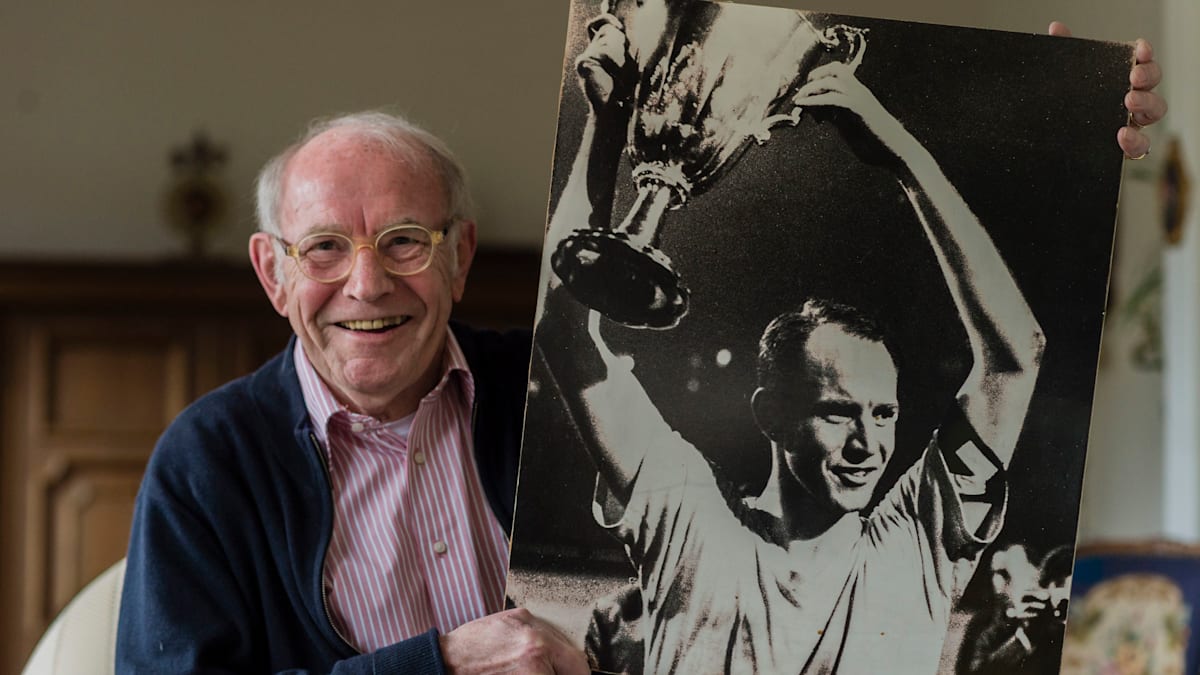
Anyone who enters Wolfgang Paul's house, located on a slope in Bigge-Olsberg in the Sauerland region, will discover a staircase leading down at the end of a short hallway. It leads to a small, very personal museum where Paul has collected memories of his wonderful career. Jerseys, trophies, photos, a ball from the 1966 World Cup final. There is also a poster from the Australian Open, the Grand Slam tournament in Melbourne, hanging there. Paul and his wife Almuth have traveled a lot, to South Africa, Australia and a few times to the USA. A tour took this couple, who had been married to each other for more than 58 years, to New York to a game played by Franz Beckenbauer, who was then under contract with the Cosmos along with Pelé. On Sunday, Wolfgang Paul began his last journey; he died at the age of 86 as a result of pneumonia. With him, Dortmund Borussia has lost one of its greatest players of all time, club legend and honorary captain, role model for generations. His nickname “Stopper” goes after former President Dr. Reinhard Rauball, he was also called a “Sauerland oak”. Paul's explanation: "The oak is large and robust. It is hard and long-lasting." But unfortunately not forever. Whoever he offered the "you" to - like me on a BVB Champions League trip - saw this as an accolade. For interview appointments, Paul welcomed me into his living room, which has at least half a dozen clocks hanging on the walls. Even those who are not familiar with the topic would quickly guess what profession Paul learned and practiced until 2018: He was a master watchmaker. I smiled and looked at the cups in which Almuth Paul, as an obliging hostess, served fresh coffee with the homemade cake: They were decorated with clock ornaments. As a player, Paul, who was used as a libero, cleaner, front stopper or middle runner depending on the system, was the man for the rough stuff. In his workshop he was the man for filigree. He was the fine man for rough things. His father Karl signed his first contract as a footballer for him; Wolfgang Paul was not yet of age. “It was his wish that I became a professional,” the young player later revealed. BVB paid him 400 marks as a starting salary, and with the founding of the Bundesliga it increased to 1,200 marks. In 1963 he celebrated winning the German championship with BVB, in 1965 he won the cup, and in 1966 he won the European Cup Winners' Cup. In the same year he became runner-up in the World Cup without ever having played an international match for Germany. Willi Schulz blocked his way. Wolfgang Paul did not become rich as a footballer. BVB only donated a bonus of 6,000 marks for the European Cup triumph in Glasgow. He could earn more somewhere else, but he would have to leave Bigge-Olsberg, the Sauerland and Borussia Dortmund. But he didn't want that. Wolfgang Paul probably played the best game of his career in the 1965/66 European Cup semi-final against West Ham United. The English were so enthusiastic about the tough defender that they wanted to hire him straight away. Paul only found out four weeks later that there was an offer. Never mind, he confided to me, "it was always clear to me that I wasn't going away." Borussia Mönchengladbach and Hamburger SV were also disappointed with their offers. For Paul, this loyal soul, the following was true: "Once a Borussia, always a Borussia. This club was a matter close to my heart." Down-to-earthness and modesty characterized the Sauerlander's life. Even when he saved a boy from drowning on Lake Garda in 1965, Paul didn't want to make a big deal about it. He was camping on Lake Garda with three friends when they suddenly heard screams. "Nobody did anything," Paul remembered, "so I jumped in and pulled the boy out. My brother-in-law, who couldn't swim very well, was more afraid for me than for the boy." This heroic act only became known much later. “I didn’t want it to become public,” he says. "For me it was a no-brainer to save the boy." Shortly before his 85th birthday in January 2025, Wolfgang Paul welcomed me again for a conversation in Olsberg. We talked about his favorite opponent Uwe Seeler ("He never managed a header goal against me") and about his feared opponent Gerd Müller ("You had to be very careful of him and his short turns"). We also talked about the fact that only three players from the 66 team are still alive: Sigi Held, Theo Redder and him. Now there are only two left.